
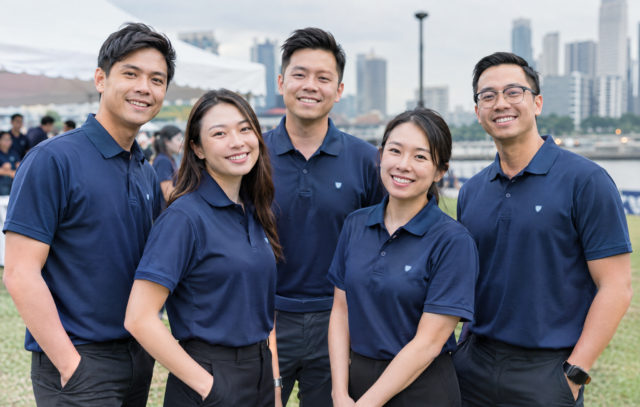
Somewhere in an HR inbox right now sits a message that reads, can we sort out polos for the team before the year-end thing? It looks like a quick task. Then the questions start. What colour, what fabric, embroidered or printed, and will the logo still look sharp after a dozen washes.
Company polos are one of those deceptively simple orders that reward a little planning. Get the finish right and you end up with something staff genuinely reach for, at events and on ordinary Fridays alike. Get it wrong and the box sits in a cupboard, untouched. The first big decision, once you have picked the shirt, is how the branding goes on. That single choice shapes the price, the feel, and how long the polos keep looking their best.
First, choose the right polo
Before you weigh up embroidery against print, settle on the garment. For Singapore’s climate, a moisture-wicking Dri Fit polo in a microfibre polyester keeps staff cooler through outdoor events and long days on their feet, while honeycomb polos and fancy Dri Fit polos offer a bit more texture and a dressier feel. A structured, well-fitted polo simply carries branding better than a limp one. Colour is part of the decision too, since a deeper shade hides the odd coffee splash better and tends to keep a company logo looking crisp for longer.
This is where a custom corporate polo tee earns its keep, giving your team a coordinated, professional look without the stiffness of a full uniform. Once the base shirt is sorted, the finish is the fun part.
Embroidery: the classic, hard-wearing finish
Embroidery stitches your logo straight into the fabric with thread, giving a raised, textured finish that feels premium the moment you run a thumb over it. It is the look most people picture when they imagine a smart corporate polo, and it ages gracefully.
Because the design is sewn instead of printed, it holds up to repeated washing without fading or cracking, which suits a shirt meant to last several seasons. It sits especially well on the left chest, on a sleeve, or on a back yoke, the classic spots for a company mark.
The trade-offs are easy to live with once you know them. Embroidery works best for logos with clean, bold shapes and a limited number of colours, since very fine detail and subtle gradients are hard to reproduce in thread. Larger designs also use more stitching, which can add to the cost, so it tends to shine on compact, crisp marks near the chest.
Printing: sharp detail and full colour
When your logo has fine detail, gradients, or several colours, printing keeps everything faithful to the original. On stretchy synthetic polos, specialised heat transfer printing is designed for the material, bonding the design to the fabric so it moves with the shirt. It reproduces intricate artwork cleanly and works nicely for smaller runs or individual names. It is also the go-to when a design carries several tones or a soft gradient that thread would struggle to capture, letting a modern, colourful logo land exactly as your designer intended.
One thing to flag: DTG (direct-to-garment) printing, brilliant as it is on cotton, is not suited to Dri Fit and other polyester fabrics, where the ink can look washed out. For moisture-wicking polos, heat transfer is the dependable choice, so match the method to the material and you will not be caught out.
Which finish for which job
If you are still on the fence, a rough rule of thumb helps:
• Premium gifts and client-facing staff: embroidery, for that tactile, lasting finish
• Colourful or highly detailed logos: heat transfer printing, to keep every detail
• Mixed teams needing individual names: heat transfer, added per person
• Tight budgets on simple marks: embroidery on small logos, or a clean single-colour print
Placement, sizing and ordering
Placement is a small choice that changes the whole feel. A left-chest logo, usually somewhere around 2.5 to 4 inches wide, reads as understated and professional, while a sleeve or back-yoke mark gives a subtler, modern touch. Consistency across the team is what pulls the look together. If your logo is wide and short, a chest placement usually flatters it, while a tall, compact mark can sit happily on a sleeve without crowding the shirt.
On quantities, there is no minimum order quantity, or MOQ, which is the smallest number some printers require, so a boutique agency of eight is as welcome as a company of three hundred. You can mix sizes across a single order, and unisex fits make it easier to cover a varied team. Many of the same reasons companies choose Dri-Fit shirts for staff uniforms apply here too, from comfort in the heat to a tidy, consistent brand look.
A quick word on care, since it protects your investment: turning the polos inside out before washing and letting them air-dry helps both stitching and prints look newer for longer. Ask for a digital proof before production, check the logo size and placement on screen, and you will avoid surprises when the box arrives. It is a two-minute check that saves a world of pain, especially when the polos are heading straight to an event with no time to spare.
Get your team looking the part
A good company polo is a small thing that quietly does a lot, making a team look pulled together at the D&D, the roadshow, and every casual Friday in between. Whether you lean towards the texture of embroidery or the detail of a printed finish, Direct T Shirt can help you weigh the options and get it right for your team. Tell us about your logo and your plans, and we will point you towards the finish that fits.
